Ever heard of the phrase “loss aversion”? The Wikipedia describes it thusly:
"In prospect theory, loss aversion refers to the tendency for people strongly to prefer avoiding losses than acquiring gains. Some studies suggest that losses are twice as powerful, psychologically, as gains. Loss aversion was first convincingly demonstrated by Amos Tversky and Daniel Kahneman."
MIT professor and author Dan Ariely, in his book “Predictably Irrational” described an experiment he and a colleague carried out on a group of college students. He was attempting to demonstrate our irrational ideas of valuation for the things we possess and, in a smaller sense, the way that an aversion to loss affects that value.
At this time of year, particularly for those of us in San Antonio, this is a relevant experiment.
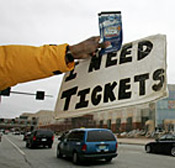
You see, Ariely focused on Duke University students who were camping out for a chance to obtain men’s basketball Final Four tickets. The students slept in tents on a campus lawn for days in order to obtain a number that would then be eligible to be “pulled” in a lottery, which would award a ticket to the number-holder. That means that the students were waiting for a chance at tickets, not tickets themselves.
Ariely was attempting to illustrate how humans irrationally value their own possessions. His theory was that we overvalue what we possess and undervalue what we seek to possess. For instance, the buyer and seller of a car are often on very predictable sides of the price war.
Ariely obtained a list of the students who had entered the lottery and a list of those who had won tickets. He then called each of the students and established a “ceiling price” for the buyers, the greatest amount they would pay for a ticket to see Duke in the Final Four. Remember, these were students who had waited and sacrificed and desperately sought tickets. He also established a “floor price” for the sellers, the least amount they would sell their ticket for. He promised each student that they would get a return call if he could match their request with another student. He never called one student back.

As it turned out, each student with a ticket wanted, on average, $2400 for the ticket. They cited the “once-in-a-lifetime-experience” among other things. The average potential buyer offered $175 for a ticket, citing the number of other needs that could be met by that amount of money and a reluctance to overspend on something that they could witness on television.
So, what happened? All of the students originally wanted tickets. They queued for the same amount of time and were randomly selected. Yet, once they were divided into ticket-owners and ticketless masses, they seemed to become very different in their attitudes towards the value of a Final Four ticket. One group became averse to loss, seeking to preserve an exclusive right (the ticket) and a potentially great experience. The other group regained sanity (my opinion) and realized the concrete value of a ticket versus the expected emotional/status gain. In other words, the aversion to loss of the sellers kept prices too high for potential buyers to become real purchasers.
In the market for a Final Four ticket this weekend? Odds are that, if you are a buyer, you’re expecting to pay too little. If you are a seller, you are asking way too much. Enjoy the weekend.
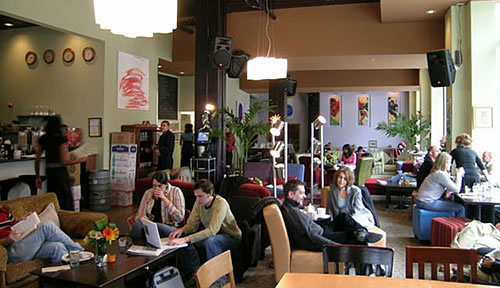 I sat and read the Kindle in a local coffee shop for several hours and I began to notice that an incredible cross-section of society was stopping by for a cup of community. Workers in overalls, businesswomen in high heels, retirees with nowhere to be anymore, and students with nowhere to be yet…
 One thing that seemed evident to me is that we are all the same. We are all seeking recognition and fulfillment, whether in lattes or lifestyles. We are all capable of compassion and kindness, of hate and vulgarity.